
Key takeaways
- Incident response in 2026 has crossed from AI-assisted to AI-autonomous for a bounded class of known Kubernetes failures. The question is no longer whether, but under what guardrails.
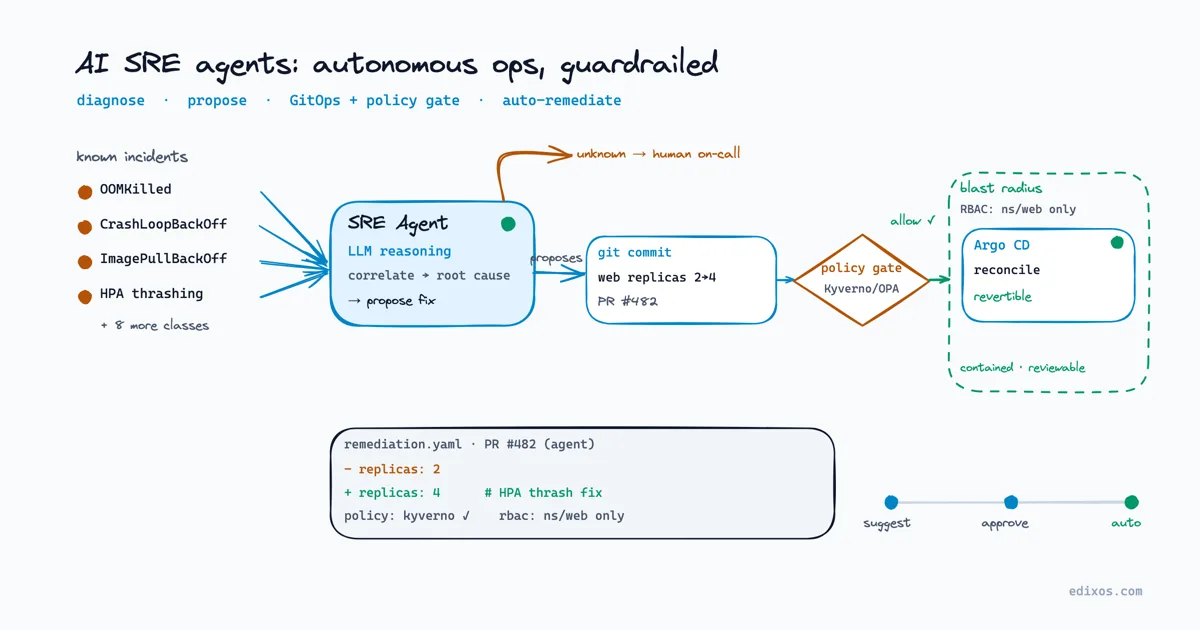
- Most Kubernetes production incidents fall into roughly 12 recurring categories — OOMKilled, CrashLoopBackOff, ImagePullBackOff, HPA thrashing, and friends. This is the toil an agent should own.
- The naive pattern is the dangerous one: an agent with broad cluster credentials and no blast-radius limits. Autonomy without guardrails is not automation, it’s an unreviewed root user.
- The pattern that works: LLM reasoning bounded by GitOps and policy. Every agent action is a reviewable, reversible commit, gated by admission control, scoped by least-privilege RBAC.
- Roll out crawl-walk-run: suggest, then approve, then auto-remediate only the failure classes the agent has proven safe on.
For years “AI for operations” meant better alerting: less noise, faster correlation, a suggested root cause. In 2026 that framing is behind the curve. The phrase has graduated from AI-assisted to autonomous incident response, and the shift is real: agents now triage an alert, run the full diagnostic sequence, and for known failure modes apply a remediation without a human in the loop. Industry surveys report the vast majority of platform teams now consider AI critical to the future of the discipline.
This is genuinely useful and genuinely dangerous, depending entirely on one design decision: what the agent is allowed to do. An agent that suggests a fix is a smart runbook. An agent with a cluster-admin token and permission to act is a liability waiting for a bad inference. The engineering that separates the two is the whole subject, and it’s where most “AI ops” projects quietly go wrong.
The 80/20 of Kubernetes incidents
Most Kubernetes production incidents are not novel. They cluster into roughly twelve recurring categories: OOMKilled pods, CrashLoopBackOff, ImagePullBackOff, failed liveness and readiness probes, HPA thrashing, network-policy misconfigurations, PersistentVolume binding failures, node pressure evictions, and a handful of others. Each has a known diagnostic path and a known, safe remediation. This is textbook toil: high-frequency, low-judgment, and exactly the work that pages an engineer at 3am for the hundredth time.
That concentration is the opportunity. When 80% of what pages your team follows a dozen predictable scripts, you don’t need general intelligence to handle it, you need reliable execution of known runbooks with fast signal-gathering. The teams pulling ahead in 2026 deployed agents against precisely this band: the incidents that don’t require human judgment. The engineer’s attention is finite and expensive; spending it on the hundredth CrashLoopBackOff is the waste.
Why “AI ops” fails without guardrails
The failure mode is seductive because it looks like progress. You give an agent broad read-write access to the cluster, a good model, and a prompt, and for a while it fixes things. Then a confident wrong inference deletes a NetworkPolicy that was load-bearing, or scales a StatefulSet in a way the model didn’t understand, and the automation that was saving you time authors an outage at machine speed. An agent with real credentials and no blast-radius limits is not an SRE, it’s an unreviewed root user with a plausible manner.
The root problem is that language models are probabilistic and operations are consequential. You cannot make the model perfect, so you must make its mistakes cheap and reversible. That is an architecture question, not a prompt-engineering one. The guardrails have to live outside the model, in the system the agent acts through, because anything you enforce only inside the prompt is a suggestion the next inference is free to ignore.
The pattern that works: reasoning inside GitOps guardrails
The durable design pairs the model’s strength with the platform’s discipline: LLM reasoning for diagnosis and proposal, GitOps and policy for action. The agent reads telemetry, correlates signals, and reasons about root cause, that’s what models are good at. But it does not touch the cluster directly. It proposes a change as a commit to the same GitOps repository your humans use, where Argo CD reconciles it and every action is, by construction, reviewable and revertible.
That single indirection changes everything. A remediation is now a diff, not an API call into the dark. It passes through the same Open Policy Agent or Kyverno admission gates as any human change, so a policy violation is refused whoever proposed it. And because GitOps state is the source of truth, undoing an agent’s action is a revert, not an archaeology project. The model brings speed and pattern-matching; the platform brings the audit trail, the policy floor, and the reversibility that make speed safe.
Define the blast radius in code
Trust is granted per failure class, and enforced by permissions, not intentions. An agent should run with least-privilege RBAC scoped to exactly the resources its approved runbooks touch, nothing more. It should have no standing cluster-admin, no blanket delete, no reach into namespaces outside its remit. The blast radius is not a policy document; it’s a Role, a set of admission rules, and a GitOps path the agent can write to and no further.
This is also how you keep humans in control of the escalation boundary. The agent handles the twelve known categories inside its scope; anything outside them, anything ambiguous, anything touching a resource it isn’t scoped for, is escalated to a person with full context already gathered. The design goal is not maximum autonomy. It’s maximum safe autonomy, with a hard, coded edge where machine confidence ends and human judgment begins.
Measure autonomy, not activity
The metrics that matter are outcome metrics: mean time to resolution, page volume, and autonomy rate — the share of incidents the agent closed without waking anyone. Teams running mature setups report large drops in routine pages and materially faster diagnosis for common failures. But watch the counter-metric too: the rate of agent actions that a human later reverted. A rising revert rate means the blast radius is too wide or a runbook is wrong, and it’s the early-warning signal that keeps autonomy honest.
Activity metrics, actions taken, alerts processed, flatter without informing. An agent that takes a thousand actions and causes two outages is worse than one that takes fifty and causes none. Measure whether reliability improved and whether trust is holding, not how busy the machine looks.
Where to start
Roll it out crawl-walk-run, and never skip a phase. Crawl: the agent only suggests, posting a diagnosis and a proposed fix to the incident channel while humans act. Walk: the agent opens the remediation as a pull request that a human approves, so you build a track record with a person on the trigger. Run: for the specific failure classes with a clean approval history, and only those, the agent auto-remediates within its coded blast radius, still through GitOps, still fully reverted-if-wrong.
Most of the value arrives before full autonomy. Even suggest-only mode collapses diagnosis time, because the agent has already gathered the signal and named the likely cause before a human opens the laptop. That is where we start with clients: the reasoning layer wired to real telemetry, acting through the GitOps and policy machinery they already trust, earning each increment of autonomy on a failure class it has proven safe on. Autonomous operations that won’t wreck prod are not a model choice. They’re a platform you engineer.
Straight answers
Frequently asked questions
What is an AI SRE agent?
An AI SRE agent is a software agent that automates site-reliability work: it triages alerts, runs diagnostics, correlates signals, and for known failure modes proposes or applies a remediation. In 2026 the mature ones handle the routine incidents that don't need human judgment, escalating the ones that do.
Can AI agents safely auto-remediate Kubernetes incidents?
Yes, for a bounded class of known failures, and only inside guardrails. Safe autonomy means the agent acts through GitOps and policy, not raw cluster write access: its changes are reviewable, reversible, and constrained by admission control. Naive agents with broad credentials and no blast-radius limits are the real risk.
What is the difference between AIOps and AI SRE agents?
Classic AIOps focuses on detection and correlation: reducing alert noise and surfacing likely root causes. AI SRE agents go a step further into action, proposing or executing remediation. The distinction that matters is whether the system only tells you what's wrong or is trusted to help fix it, and under what guardrails.
Which Kubernetes incidents should agents handle first?
Start with the high-frequency, well-understood failure modes: OOMKilled pods, CrashLoopBackOff, ImagePullBackOff, and HPA thrashing. These follow known diagnostic paths and safe remediations, so they're ideal for suggest-then-approve automation before you grant any autonomous action.
How do you keep an AI SRE agent from making things worse?
Bound its blast radius in code. Give it least-privilege RBAC, route changes through GitOps so every action is a reviewable, revertible commit, gate them with Kyverno or OPA policy, and run a crawl-walk-run rollout: suggest, then approve, then auto-remediate only the failure classes it has proven safe on.
Do AI SRE agents replace SRE teams?
No. They absorb the repetitive toil, the 3am pages for known failures, so engineers spend their judgment on novel problems, architecture, and reliability design. The teams winning in 2026 use agents to handle more infrastructure per engineer, not to remove the engineers.