PROTOCOL_ID: XP-08 CLASS: KNOWLEDGE_TRANSFER
Crossplane Training
Four days on real clusters, after which your engineers ship compositions without us.
Difficulty: 2 / 3
Engagement overview
Most Crossplane training stops at the demo: install the provider, apply a managed resource, watch a bucket appear. That is the first afternoon. The hard part starts when a composition has to model something your business actually provisions, survive a schema change, and stay debuggable when the reconcile loop goes quiet.
So the track is built around the failure modes. Engineers write XRDs and compositions against a live cluster, then we break them: a patch that silently does nothing, a provider credential that rotates mid-reconcile, a composite stuck because one managed resource never becomes ready. Reading those states is the skill that separates someone who has seen Crossplane from someone who can run it.
We also cover the part nobody teaches: deciding what not to abstract. Every field you expose is a promise you maintain, and the teams who struggle are usually the ones who exposed everything. By the end, your engineers can design a control-plane API, implement it, and defend the boundary they drew.
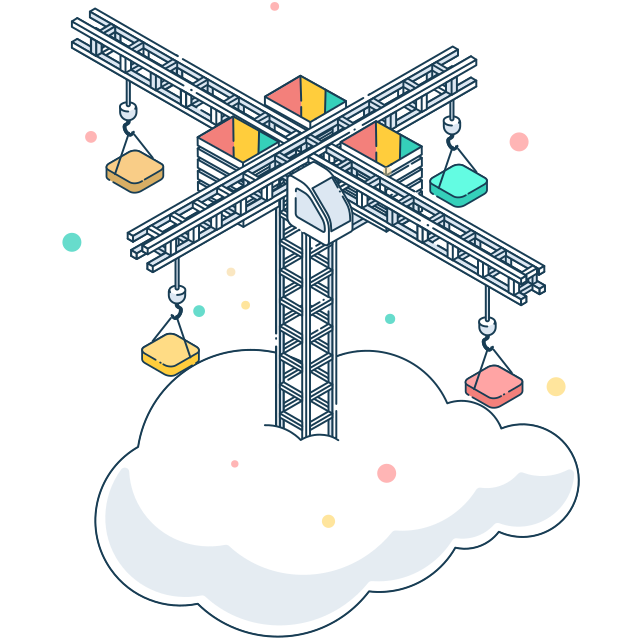
Illustrative schematic, not live telemetry
Tools in this engagement
Tools in this engagement
- Crossplane
- crossplane-cli
- Kubernetes
- Argo CD
- Kyverno
- Helm



From assessment to production
- 01
Day one, foundations
The Kubernetes resource model, providers, managed resources, and why Crossplane reconciles rather than applies.
- 02
Day two, compositions
XRDs, compositions, patches and transforms, written against a live cluster rather than slides.
- 03
Day three, debugging
Deliberately broken control planes. Trace a stuck composite from claim to managed resource and back.
- 04
Day four, production
GitOps delivery with Argo CD, policy with Kyverno, upgrade strategy, and writing a provider when the ecosystem has none.
- 05
Follow-up
A review session a few weeks later, against the compositions your team has written since.
Ecosystems, tooling, and deliverables
| Target ecosystems |
|
|---|---|
| Tooling |
|
| Deliverables |
|
| Prerequisites |
|
Straight answers
Frequently asked questions
How long is the Crossplane training, and in what format?
Four days, hands-on throughout, for groups of 4 to 12 engineers. Delivery is on-site, remote or hybrid, in English or French, and a review session a few weeks later goes over the compositions your team has written since.
What level do our engineers need beforehand?
Working Kubernetes knowledge, roughly CKA level, plus comfort with YAML and the command line. No prior Crossplane exposure is expected. Day one covers the resource model, providers and managed resources before anything is composed.
Do we need to provide a cluster?
Either works. Engineers can train on your own clusters, which makes the exercises closer to your real estate, or on a lab environment we provide. Everything is written against a live cluster rather than slides.
Does this track prepare for a certification?
No, and it is not built as exam preparation. The four days are organised around production failure modes: reading a stuck composite, a patch that silently does nothing, a credential that rotates mid-reconcile. If you want a CNCF certification path for your team, that sits on our general Kubernetes training track instead.